Month-end Close Takes Longer Than It Should for Foodservice Manufacturers

When deduction data lives across ERP exports, distributor spreadsheets, and shared drives, Finance closes the books on estimates vs. actuals. The Claims Processing Module in MarginIQ™ changes what's available at the point of decision.
Fragmented inputs delay financial visibility, not just resolution speed.
When a deduction is taken, the manufacturer needs three things in the same view: the original contract terms, proof that the trade program performed, and the distributor's shipment data. In most organizations, those three elements come from three different systems in three different formats requiring manual assembly before validation can begin.
48% of organizations cite human error during manual data input as a source of inconsistencies in trade spend reporting, according to an iTradeNetwork survey. That error rate compounds at month-end close, when Finance is reconciling accruals against actuals at scale.
%20(1).png)
A standardized layer replaces the manual assembly step.
The Claims Processing Module ingests records from ERP, EDI, and distributor feeds and aligns them against the contract terms and trade program data already stored in MarginIQ. By the time a deduction reaches the validation queue, the matching data is already attached. Finance does not build the picture from scratch.
The dashboard gives Finance and AR a single view of what is outstanding, what is disputed, and what is aging beyond target. Deduction Days Outstanding (DDO) is visible as a headline metric, with drill-down access to the line-item detail driving it.
%20(1).png)
Resolved decisions post to ERP without a re-entry step.
Manual re-entry of resolved deduction decisions is one of the most common sources of delay in month-end close. A claim approved in one system requires a separate posting step in another. Posting errors create reconciliation loops that push close further out.
Direct financial posting where resolved claim decisions move automatically to AP, AR, or ERP removes that step. Finance closes on what actually resolved, not what they estimated would resolve based on available data.
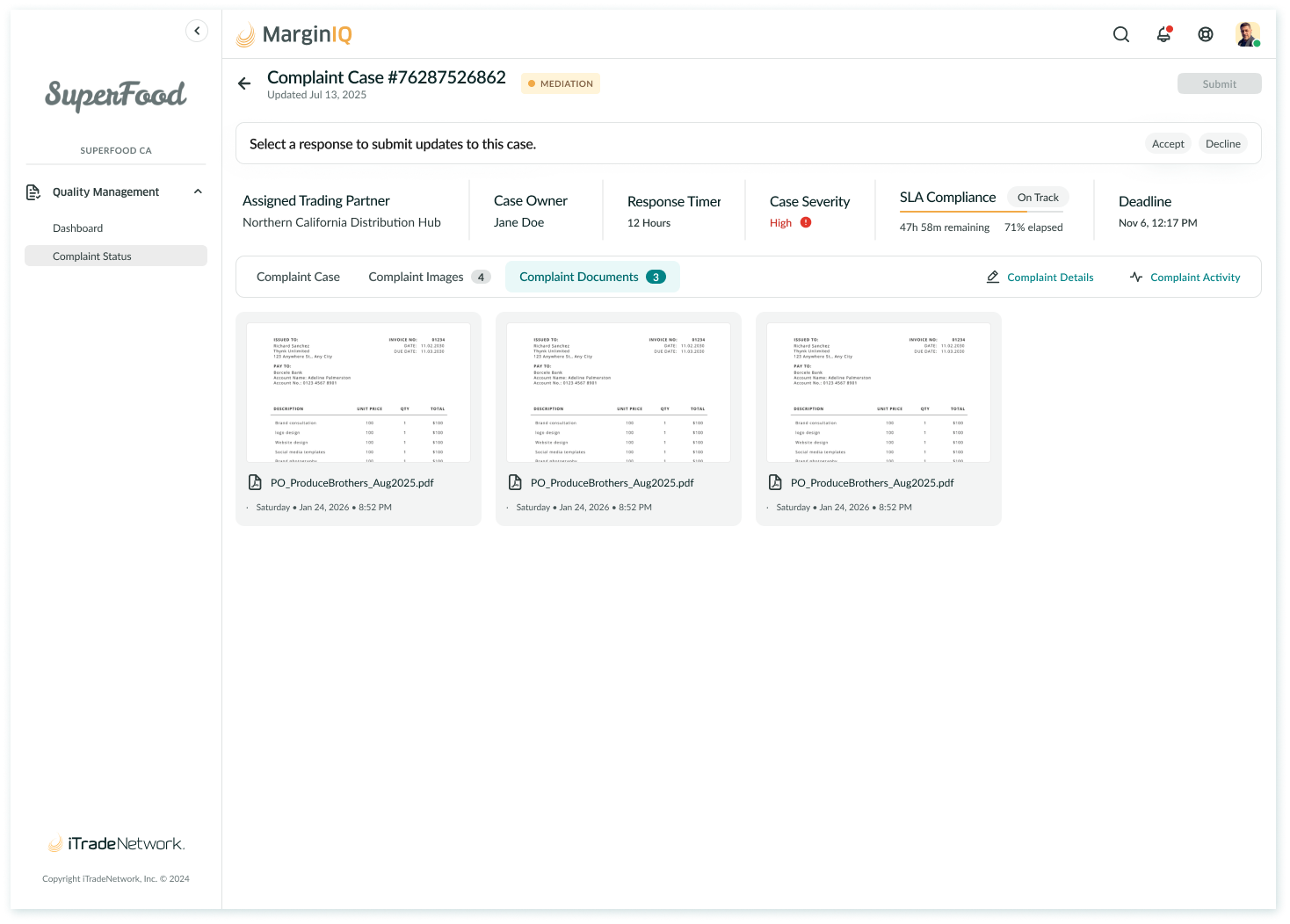
Account-level visibility changes what Finance can act on before the window closes.
The Claims Processing Module provides visibility from each line item all the way to the account level where each deduction stands, what action it requires, and how it maps to the distributor relationship. For top-delinquent accounts, that aggregated view replaces individual claim-by-claim investigation.
For foodservice manufacturers managing complex distributor networks, the claim data pipeline is often the most fragmented part of the financial stack and the most recoverable.
See how the Claims Processing Module structures deduction data and what it can change for your Finance team's close cycle. Book a MarginIQ walkthrough→
Redefine the revenue impact of freight data & analytics
Uncover what clients and clientele are prioritizing in today’s shifting freight and logistics landscape.
Redefine the revenue impact of freight data & analytics
Uncover what clients and clientele are prioritizing in today’s shifting freight and logistics landscape.
Speak to an Expert
Take a closer look at the platform built for buyers and their trading partners
Month-end Close Takes Longer Than It Should for Foodservice Manufacturers
When deduction data lives across ERP exports, distributor spreadsheets, and shared drives, Finance closes the books on estimates vs. actuals. The Claims Processing Module in MarginIQ™ changes what's available at the point of decision.
Fragmented inputs delay financial visibility, not just resolution speed.
When a deduction is taken, the manufacturer needs three things in the same view: the original contract terms, proof that the trade program performed, and the distributor's shipment data. In most organizations, those three elements come from three different systems in three different formats requiring manual assembly before validation can begin.
48% of organizations cite human error during manual data input as a source of inconsistencies in trade spend reporting, according to an iTradeNetwork survey. That error rate compounds at month-end close, when Finance is reconciling accruals against actuals at scale.
A standardized layer replaces the manual assembly step.
The Claims Processing Module ingests records from ERP, EDI, and distributor feeds and aligns them against the contract terms and trade program data already stored in MarginIQ. By the time a deduction reaches the validation queue, the matching data is already attached. Finance does not build the picture from scratch.
The dashboard gives Finance and AR a single view of what is outstanding, what is disputed, and what is aging beyond target. Deduction Days Outstanding (DDO) is visible as a headline metric, with drill-down access to the line-item detail driving it.
Resolved decisions post to ERP without a re-entry step.
Manual re-entry of resolved deduction decisions is one of the most common sources of delay in month-end close. A claim approved in one system requires a separate posting step in another. Posting errors create reconciliation loops that push close further out.
Direct financial posting where resolved claim decisions move automatically to AP, AR, or ERP removes that step. Finance closes on what actually resolved, not what they estimated would resolve based on available data.
Account-level visibility changes what Finance can act on before the window closes.
The Claims Processing Module provides visibility from each line item all the way to the account level where each deduction stands, what action it requires, and how it maps to the distributor relationship. For top-delinquent accounts, that aggregated view replaces individual claim-by-claim investigation.
For foodservice manufacturers managing complex distributor networks, the claim data pipeline is often the most fragmented part of the financial stack and the most recoverable.
See how the Claims Processing Module structures deduction data and what it can change for your Finance team's close cycle. Book a MarginIQ walkthrough→
Unlock It Now!