What Happens Between a Deduction and a Resolved Claim in MarginIQ

Foodservice manufacturers lose margin in the gap between when a deduction is taken and when it's actually reviewed. The MarginIQ Claim Processing Module closes that gap at every stage of the lifecycle.
Deductions arrive. Then the manual work begins.
A distributor short-pays an invoice. The reason code says "trade promotion," but your AR team spends the next two weeks locating the original contract, matching it against shipment records, and chasing proof-of-performance data scattered across three systems. By the time the deduction is validated, the window to dispute it has narrowed. In many cases, it gets written off.
This is not a workflow problem. It is a data structure problem. The information needed to validate a claim exists; it is not organized around the moment a deduction is taken.
.png)
Ingestion, matching, validation in that order, every time.
The Claim Processing Module manages the full lifecycle: data ingestion from ERP, EDI, and distributor feeds; automatic matching against contract terms and proof-of-performance data already in MarginIQ; structured approval and dispute routing; and direct posting of resolved decisions to your financial system.
Matching happens during trade execution, not weeks after the short payment has already cleared. Every deduction is compared to the relevant contract, shipment record, and Electronic Proof of Delivery (ePoD) data automatically. Finance can begin validating on day one.
.png)
.png)
Every claim has a status. Every status triggers the right action.
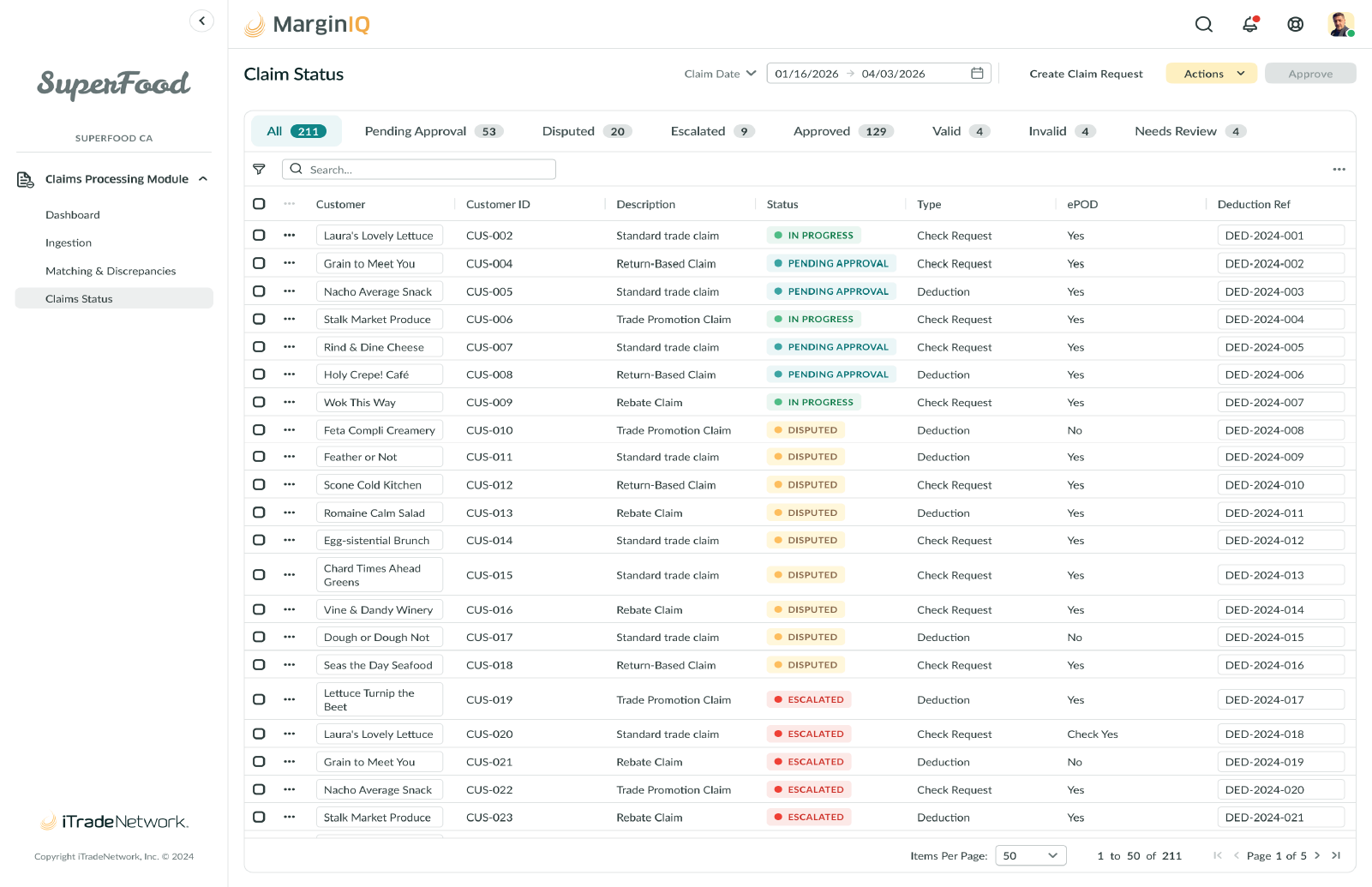
The Claim Status view gives Finance and AR a single screen showing every deduction in the workflow pending approval, disputed, escalated, or archived. Ingestion type is visible at the line level (ePOD, EDI, Manual), so teams know immediately how a claim arrived and what proof is available to act on it.
Escalated claims are flagged in red. Disputed claims surface the validation data that supports or challenges the deduction. Nothing moves to the next stage without the validated contract and Proof of Purchase (PoP) data attached.
When a deduction can't be resolved in the first pass, the process doesn't stall.
Disputed or escalated claims route to structured resolution workflows. Supporting documents attach directly to the claim record POs, invoices, proof of performance so both sides of a conversation have the same data. SLA compliance is tracked against each case, with a timer showing time remaining and percentage elapsed.
.png)
Backlog direction matters as much as total outstanding.
The year-over-year comparison chart shows not just how many deductions exist, but whether the backlog is growing or shrinking. A positive net (closed minus new) means the pipeline is clearing. When claim matching moves from manual to automated, manufacturers recover margin that previously got written off.
See how the Claims Processing Module in MarginIQ can take every deduction from ingestion to financial posting without a manual handoff. Request a Demo Today →
Redefine the revenue impact of freight data & analytics
Uncover what clients and clientele are prioritizing in today’s shifting freight and logistics landscape.
Redefine the revenue impact of freight data & analytics
Uncover what clients and clientele are prioritizing in today’s shifting freight and logistics landscape.
Speak to an Expert
Take a closer look at the platform built for buyers and their trading partners
What Happens Between a Deduction and a Resolved Claim in MarginIQ
Foodservice manufacturers lose margin in the gap between when a deduction is taken and when it's actually reviewed. The MarginIQ Claim Processing Module closes that gap at every stage of the lifecycle.
Deductions arrive. Then the manual work begins.
A distributor short-pays an invoice. The reason code says "trade promotion," but your AR team spends the next two weeks locating the original contract, matching it against shipment records, and chasing proof-of-performance data scattered across three systems. By the time the deduction is validated, the window to dispute it has narrowed. In many cases, it gets written off.
This is not a workflow problem. It is a data structure problem. The information needed to validate a claim exists; it is not organized around the moment a deduction is taken.
Ingestion, matching, validation in that order, every time.
The Claim Processing Module manages the full lifecycle: data ingestion from ERP, EDI, and distributor feeds; automatic matching against contract terms and proof-of-performance data already in MarginIQ; structured approval and dispute routing; and direct posting of resolved decisions to your financial system.
Matching happens during trade execution, not weeks after the short payment has already cleared. Every deduction is compared to the relevant contract, shipment record, and Electronic Proof of Delivery (ePoD) data automatically. Finance can begin validating on day one.
Every claim has a status. Every status triggers the right action.
The Claim Status view gives Finance and AR a single screen showing every deduction in the workflow pending approval, disputed, escalated, or archived. Ingestion type is visible at the line level (ePOD, EDI, Manual), so teams know immediately how a claim arrived and what proof is available to act on it.
Escalated claims are flagged in red. Disputed claims surface the validation data that supports or challenges the deduction. Nothing moves to the next stage without the validated contract and Proof of Purchase (PoP) data attached.
When a deduction can't be resolved in the first pass, the process doesn't stall.
Disputed or escalated claims route to structured resolution workflows. Supporting documents attach directly to the claim record POs, invoices, proof of performance so both sides of a conversation have the same data. SLA compliance is tracked against each case, with a timer showing time remaining and percentage elapsed.
Backlog direction matters as much as total outstanding.
The year-over-year comparison chart shows not just how many deductions exist, but whether the backlog is growing or shrinking. A positive net (closed minus new) means the pipeline is clearing. When claim matching moves from manual to automated, manufacturers recover margin that previously got written off.
See how the Claims Processing Module in MarginIQ can take every deduction from ingestion to financial posting without a manual handoff. Request a Demo Today →
Unlock It Now!